A song written for a specific moment doesn’t sound like a song pulled off a playlist because it seemed to fit, and you can usually tell the difference before you could ever explain it, the way you can spot a handwritten letter before you’ve read a single word of it. When you book a songwriter in Switzerland, it isn’t really about hiring entertainment. You’re choosing presence over background noise, a real human voice over whatever a streaming algorithm decided everyone probably likes this month. What follows is my attempt to walk you through what that choice actually involves, from the questions worth asking to the numbers you should expect, so you’re working from something more solid than a guess.
Key Takeaways
- Booking a songwriter gets you original live music or a custom composition built around your event, not another well curated playlist.
- Prices in Switzerland tend to range from around CHF 120 for smaller performances up to CHF 800 or more for established artists. Custom songs are priced on their own.
- There’s a real, working network of songwriters here, loosely held together by organizations like SUISA and Sonart, which makes finding someone legitimate easier than it might sound.
- The single most useful thing you can hand a songwriter before booking is a clear brief: the date, the venue, and whether you’re after a live performance, a custom song, or both.
- The process itself is simple in outline: an inquiry, a real conversation, then a contract and deposit before any writing or performing begins.
By the end you’ll know roughly how to find the right person for your event, what to ask before you sign anything, and what a fair budget actually looks like.
Why Live Songwriting Still Matters in a Streaming World
Music is everywhere now, tucked into every café and waiting room and lift, playing to nobody in particular. Somewhere in all that abundance, one thing went missing: none of it was written with you in mind. A live songwriter brings the opposite of that. They’re writing and playing for this room, this occasion, this specific handful of people who actually showed up.
That specificity isn’t a modern gimmick bolted onto an older idea. It’s closer to the original idea. People sought out musicians long before recordings existed, and live performance still carries a weight that a well built playlist can’t quite reach, for roughly the same reason. Picture what it means for a wedding guest to hear a song written about the actual couple standing in front of them, not a song that merely reminds them of some other couple entirely. Or for colleagues at a year end dinner to hear a melody built around the specific year they all just survived together. That kind of song doesn’t get performed at an audience so much as handed to them, which sounds like a small distinction on paper and turns out to be a much larger one in the room.
I’ve been performing live at concerts and private events for more than fifteen years, and the pattern has held the whole time. People remember the moments when the music felt personal, almost never because it was technically flawless, usually because it felt real in a way that’s rare on a stage. A live songwriter is one of the more direct routes to that kind of moment at any event, and the streaming era hasn’t dulled that at all. If anything, an ocean of impersonal recorded music has made one performance made specifically for you feel almost startling by contrast. When everything’s available instantly, the thing made only for you becomes the rare object in the room, and rare things carry weight whether or not anyone can say exactly why.
The Swiss Songwriter Scene: What You Should Know
Switzerland has a working songwriter community that’s more active than most people outside it realize, and a lot less flashy than that sentence might suggest. From the German speaking cantons through to French speaking Romandy, artists are writing and performing original music across a wide stretch of styles. Acoustic folk sits next to pop, which sits next to country influenced work, which sits next to a handful of things I still don’t have a proper name for.
Part of what makes this possible is the infrastructure. Sonart, the Swiss network for music professionals, supports independent musicians and helps connect artists with opportunities across the country. SUISA, Switzerland’s music rights organization, also plays an active role in the songwriting community. Their annual SUISA Songwriting Camp brings together Swiss writers to collaborate and develop new material, which says something about how seriously the craft gets taken here, even without an audience watching.
There’s also a properly multilingual streak running through the scene. A songwriter based in Bern might slide comfortably between Swiss German and English inside the same set. Someone from Lausanne might write almost entirely in French. Worth thinking about before you book, since the language of a performance shapes how it lands with your particular crowd more than most people expect going in.
Regional Differences Worth Noting
The German speaking cantons, Zurich, Bern, St. Gallen among them, tend to have the highest concentration of working singer songwriters, mostly because that’s where the population is. But artists travel more than the map suggests. Most list themselves as available across several cantons, so geography shouldn’t be your first filter. Style, language, and the particular feel of someone’s work matter far more, and they’re considerably harder to change than a train ticket.
Types of Bookings: Live Performance vs. Custom Song
Before you reach out to anyone, it helps to be clear with yourself about what you’re actually after, since these are two different services and not every songwriter offers both.
A live performance booking means the artist shows up and plays, usually a set built from their own original catalogue, sometimes with a few covers folded in depending on the brief. What you’re paying for is atmosphere and presence: an actual person making music in the room in real time.
A custom song commission works differently. You’re asking someone to write a brand new piece of music around a brief you give them: a song about a couple for a wedding, a piece for a milestone birthday, an original composition for a corporate video or a product launch. The artist delivers it as a recording, a live performance, or sometimes both together.
Combining Both Services
Plenty of events benefit from doing both at once, a short live set plus one custom song written specifically for the occasion, which usually ends up being the thing people are still talking about on the drive home. If you’re leaning toward that combination, say so clearly in your very first message. It changes how much preparation time the artist needs, and it changes the final number on the invoice too.
| Service Type | Best For | Lead Time Needed |
|---|---|---|
| Live performance only | Parties, dinners, festivals | 2–4 weeks |
| Custom song only | Gifts, videos, campaigns | 4–8 weeks |
| Live performance + custom song | Weddings, milestone events | 6–12 weeks |
How to Book a Songwriter in Switzerland Step by Step
The process follows a fairly predictable sequence, and knowing it ahead of time saves both sides a fair amount of back and forth. The real first step has nothing to do with sending a message. It starts with listening.
Step One: Listen Before You Write
Find recordings of the artist’s work before you make contact. Most Swiss songwriters have material up on streaming platforms or on mx3.ch. Give it three or four songs properly, not as background noise while you do something else. Then ask yourself, plainly, whether the style fits your event and your particular group of people. A style mismatch is the single most common source of disappointment I’ve seen, and it’s also the easiest one to avoid, before a single email even gets sent.
Step Two: Make a Specific First Inquiry
When you do reach out, be specific from the start. Give the date, the venue, and roughly how many people will be there. Say clearly what you’re after, whether that’s a live performance, a custom song, or both. A vague inquiry takes longer to answer, and sometimes it simply doesn’t get answered at all, not out of rudeness but because there’s nothing solid to respond to yet.
Step Three: Have a Real Conversation
Most songwriters will want a real conversation before confirming anything, and it’s not a formality dressed up to look thorough. It’s the point where both sides work out whether this collaboration actually feels right. Say what you’re hoping for and ask about their experience with events like yours. A short call tends to reveal more in ten minutes than a week of emails ever will.
Step Four: Confirm with a Contract and Deposit
Once you’ve agreed on terms, ask for something in writing. A standard contract covers the date, the agreed service, the fee, and the cancellation terms, along with any technical needs like sound equipment or a small stage. Most artists ask for a deposit somewhere between ten and thirty percent to lock the date, with the rest due on or around the event itself.
Step Five: Stay in Touch Before the Event
A brief check in one or two weeks out is good practice on both sides. Confirm the logistics, flag anything that’s changed. This matters even more when a custom song is involved, since the artist may still have a question or two shaping the final version right up until close to the deadline.
What to Look for in a Songwriter
Not every talented musician is the right fit for every event, and the things that actually matter rarely show up in a press photo or a follower count.
Substance Over Image
The most effective songwriters are almost never the ones with the slickest marketing. Their music carries real emotional weight on its own, without needing much dressing up around it, and you can usually tell within thirty seconds of listening whether a song feels lived in or merely rehearsed. Audiences feel that difference too, even if they couldn’t put words to it afterward if you asked them directly.
Look for someone whose original material seems to come out of an actual life rather than a formula someone taught them once.
Communication and Reliability
How someone communicates before the booking tells you a surprising amount about how they’ll behave on the day itself. Do they reply promptly. Are they clear about what they can and can’t do. Do they ask specific questions about your event, rather than the generic kind that could apply to anyone’s. None of this is a minor detail. Someone who’s clear and responsive during the planning phase is almost always easier to work with once the actual day arrives and something inevitably needs adjusting on the fly.
Experience with Live Events
Studio work and live performance pull on different muscles entirely, so it’s worth asking directly about someone’s experience with events similar to yours. A songwriter who’s played private events for a decade or more has learned things a purely studio artist simply hasn’t had reason to: how to sit inside an unexpected silence without panicking, how to read and adjust a room’s energy on the fly, how to hold people’s attention with one instrument and no stage production to hide behind.
Experience isn’t a guarantee of fit, but it’s a signal worth weighing seriously.
Understanding Pricing and What Affects It
Pricing for songwriters in Switzerland spans a fairly wide range, and the variation follows a logic, even if it doesn’t look that way from the outside at first glance.
At the lower end, you’ll find singer songwriters available from around CHF 120 for shorter sets at smaller events. More established artists typically charge CHF 800 or more for a full performance, generally people with a proper catalogue and touring history behind them, along with a track record at corporate or higher profile private events. Custom songs are usually priced separately from live performance fees entirely.
Factors That Affect the Fee
Performance length is one of the clearest factors: a thirty minute acoustic set costs less than a full two hour show, unsurprisingly. Travel distance matters too. An artist crossing the country will often fold travel costs into the quote, and some add a day rate if an overnight stay is involved. The type of event plays a role as well. Corporate events and formal weddings tend to carry higher fees than a casual private party, partly because the preparation required is greater and partly because the stakes feel higher to the client, understandably.
For a custom song, the fee mostly reflects the time invested in writing, arranging, and either recording or rehearsing the piece properly. A song that goes through several rounds of revision costs more than one that lands cleanly on the first try, which is exactly why it pays to agree on the number of included revisions before any writing begins, not after.
What Is Usually Included
Most quotes cover the artist’s time on the day, basic amplification for a small indoor space if needed, and any preparation that was explicitly agreed upon. What’s often left out: travel costs and accommodation for artists coming from further afield, larger PA systems for outdoor events, and any recording or licensing rights attached to a custom song. Worth asking about all three directly, so the final invoice doesn’t arrive with a surprise attached to it.
Events That Benefit Most from a Live Songwriter
Almost any gathering can be lifted by original live music, but a handful of events have a particularly natural fit with what a songwriter actually does.
Weddings are the obvious one. A custom song written about the couple, played live during the ceremony or over dinner, creates a moment no DJ set could ever replicate, mostly because the song exists specifically because of these two people and nobody else on earth. It won’t play on any playlist anywhere else in the world. That singularity is more or less the entire point.
Milestone Celebrations
Big birthdays, a fortieth, a fiftieth, a sixtieth, tend to be occasions where a custom composition works unusually well as a gift. Whoever commissions it shares memories, inside jokes, key moments from that person’s life, and the songwriter weaves those details into the lyrics. What comes out the other end is something the recipient couldn’t have predicted, which is exactly what separates it from a gift you could have simply bought off a shelf.
Corporate Events and Team Gatherings
Corporate events benefit from live music in a way background playlists just can’t manage. A songwriter performing during dinner gives people something to talk about that isn’t work, for once. Some songwriters also offer a collaborative writing workshop, where a whole team writes a song together during the event itself, which doubles as a team building exercise and leaves everyone with something they actually made, rather than another branded tote bag nobody asked for.
Intimate Concerts and Cultural Events
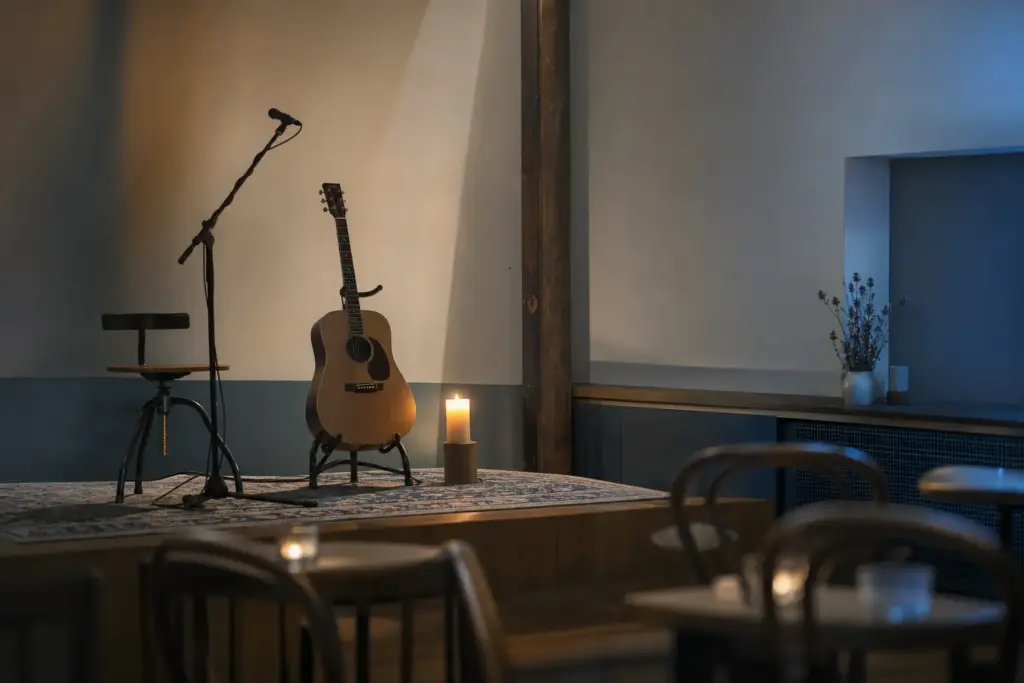
For a small cultural evening, a private concert, or an arts night, a songwriter is often a better fit than a full band. The setup stays minimal, the format flexible. One person, one guitar, one microphone, and that’s enough to fill a room of twenty or two hundred with something that lands. Smaller formats sometimes create more connection, not less, mostly because there’s nowhere for the performance to hide, and that exposure is, again, roughly the whole point.
Making the Collaboration Work
A good booking works less like a transaction and more like a collaboration, even though it starts out looking like the first one on paper, and how well that collaboration goes shapes the final result more than almost anything else, especially when a custom song is on the table.
The single most useful thing you can bring to that first conversation isn’t a technical brief. It’s a straightforward answer to a harder question: what do you want people to feel in that room, and what story do you want the music carrying underneath everything else that’s happening. A songwriter works far better with that kind of clarity than with a tidy list of specifications, even though specifications feel more organized to hand over on paper.
Giving the Artist Space to Work
Once you’ve shared the brief, the most useful thing you can do is step back and let the songwriter actually interpret it. Not because your ideas don’t matter, but because the craft and instinct you’re paying for only shows up when there’s room for it to. Micromanaging the creative process tends to produce something technically fine and emotionally flat, which is more or less the opposite of what you booked someone for in the first place. Share everything relevant up front, then let the process run, and agree on when you’ll see a first draft. For a custom song, two to three weeks before the event is usually enough time for adjustments without anyone feeling rushed.
On the Day of the Event
Introduce the songwriter to whoever’s running the venue, and make sure they know exactly where to set up. Confirm when soundcheck happens and what the rest of the schedule looks like around it. A twenty minute buffer before the performance begins is a small courtesy that makes a real difference. Artists who feel relaxed and prepared simply perform better, and that’s not a hunch so much as the consistent experience of anyone who’s organized live music more than once. If you can, be there for the performance yourself. The connection between a songwriter and an audience that’s actually paying attention is the thing you booked in the first place, and it matters more than people expect to actually be present for it, not just to have arranged it from a distance.
Frequently Asked Questions
How much does it cost to book a songwriter in Switzerland?
Prices vary widely depending on experience and event type. You’ll find singer songwriters available from around CHF 120 for smaller gigs, while established artists may charge CHF 800 or more. Custom song commissions are priced separately from live performance fees.
How far in advance should I book a songwriter for my event?
For private events, booking four to eight weeks ahead is a good rule of thumb. For weddings or large corporate events, three to six months in advance gives both you and the artist enough time to prepare, especially if a custom composition is involved.
Can a songwriter write a custom song specifically for my wedding or event?
Yes. Many songwriters in Switzerland offer custom song commissions as a separate service. You share your story, key moments, or a theme, and the artist writes original lyrics and melody around them. Discuss the brief and timeline before confirming the booking, and clarify the revision process as well. For more detail on the process, see our guide on how a custom song is written.
What information should I give a songwriter when making an inquiry?
Share the event date and venue, along with audience size. Include your preferred musical style and whether you want a live performance, a custom composition, or both. The more specific you are, the easier it is for the artist to confirm availability and send an accurate quote.
Is it possible to book a songwriter in Switzerland for a corporate event, not just a private party?
Absolutely. Songwriters regularly perform at corporate dinners and product launches, as well as team events. Some also offer songwriting workshops where colleagues collaborate on an original song together, which can work well as a team-building activity. For more on this, read 7 reasons to hire a songwriter for events that guests will never forget.
If you are ready to take the next step and are looking for how to plan wedding music or other live music for your event, I would like to invite you to visit my artist page to hear recordings, learn more about what I offer, and get in touch directly. A short message is all it takes to start the conversation.