
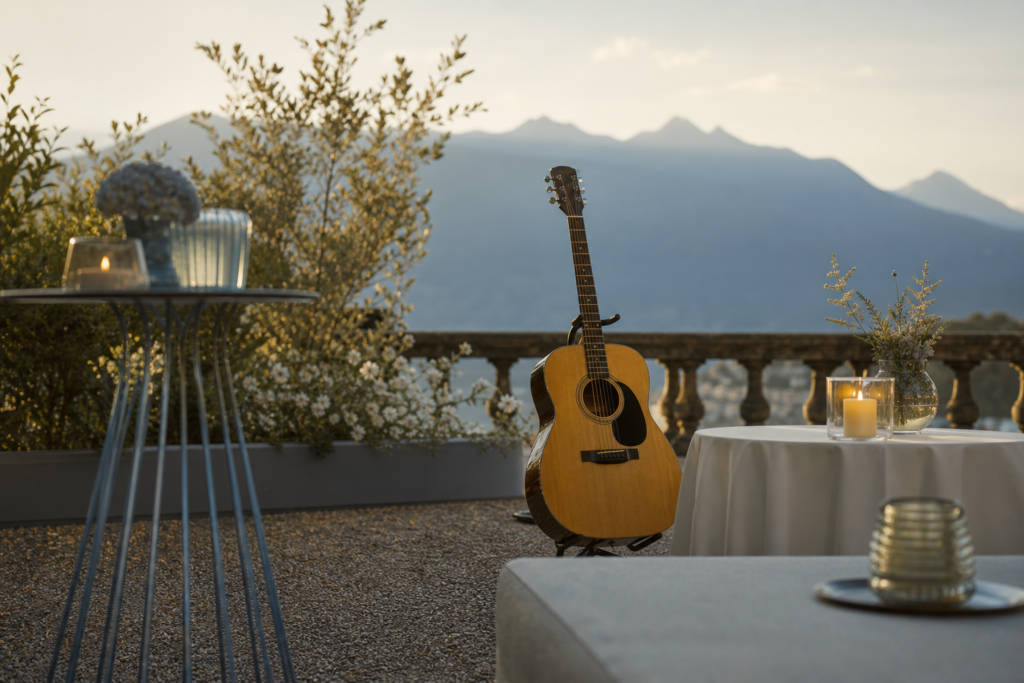
You already know you want live music at your event. The question is actually simpler than it first appears: where do you hire a guitarist in Switzerland who will read the room well and play music that reaches people rather than just filling silence? To hire a guitarist Switzerland is to commission a live performance by a skilled musician who shapes the atmosphere of your event in real time, responding to the energy in the room rather than running a fixed playlist. This guide walks you through everything you need to make that decision with confidence.
Key Takeaways
- Hiring a guitarist in Switzerland typically costs around CHF 500 on average, though rates vary by musician, style, and event duration.
- Switzerland has a large pool of guitarists available across regions, from Zurich to Lucerne, covering acoustic and jazz styles as well as pop.
- When you hire a guitarist in Switzerland, asking for a live demo or video sample before booking is standard practice and tells you far more than a profile page alone.
- The right guitarist for a wedding ceremony will not necessarily suit a corporate cocktail hour — matching style to setting matters as much as technical skill.
- Booking a guitarist well in advance, ideally several months before your event date, protects you from last-minute unavailability, especially in peak summer season.
By the end of this guide, you will be able to identify the right type of guitarist for your event and ask the right questions before signing anything. You will also learn to avoid the most common booking mistakes that leave people disappointed.
Why Live Guitar Music Changes the Feel of an Event
There is a difference between music that plays in the background and music that actually does something to a room. Live guitar music does something. It is not a matter of volume or genre. It is presence. A single guitarist sitting in the corner of a garden reception or a hotel lobby can shift the entire register of an event within the first two minutes.
A playlist, however carefully assembled, is static. It does not notice when the mood shifts after the speeches, or when a lull calls for something quieter. A live musician does. They read people and adjust accordingly.
The guitar is particularly well suited to this because it is acoustically flexible. It can be intimate or projected, and it works as fingerpicked or strummed. It works without amplification in smaller rooms in a way that few other instruments manage. That range is real, and it matters when you are planning across different spaces such as an outdoor terrace or a stone-walled cellar. Hotel ballrooms present their own acoustic considerations.
For guests, live performance also signals something about how seriously the host took the occasion. Not in an ostentatious way. More the way a handwritten place card signals care without announcing it. People notice, even when they do not consciously register what they are noticing.
Over more than 15 years of performing live music at concerts and private events, the pattern is consistent: the moments that guests remember and mention afterward are almost always connected to something live, something that happened in the room and could not have been recorded in advance.
Types of Guitarists Available in Switzerland
Switzerland has a wide range of guitarists working across styles, and knowing the difference between them before you book will save you from a mismatch that no amount of goodwill can fix on the night. The style of guitarist you need depends almost entirely on the setting and the mood you are trying to create.
Acoustic and Fingerstyle Guitarists
These musicians play without a band and often without amplification in smaller spaces. They suit wedding ceremonies and intimate dinners. Background music for receptions where conversation is the priority also works well. The sound is warm and immediate. It does not compete with people talking. It sits underneath the conversation and holds it together.
Jazz Guitarists
A jazz guitarist brings a specific sophistication that works well for cocktail hours and gallery openings. Corporate receptions where the atmosphere needs to feel relaxed and considered benefit equally. Jazz guitar is harmonically rich, and a good jazz guitarist can move between standards and original material fluidly, adjusting tempo and feel to the room. Several professional jazz guitarists based in Lucerne and Zurich work specifically in live music for events.
Singer-Songwriters and Vocalist-Guitarists
Some guitarists also sing, which doubles the impact of a solo performance. A singer-songwriter can cover recognizable songs or play original material. Many do both, and that flexibility is very useful when you want live music that also holds attention rather than purely fading into the background. If you are looking for a songwriter and singer near Lake Constance, this combination of voice and guitar creates a full, self-contained sound that works across a range of event types.
Electric and Rock Guitarists
For parties and corporate events with a louder brief, an electric guitarist or a guitarist fronting a small band makes more sense than an acoustic soloist. Outdoor summer festivals also call for this approach. The energy is different. It asks people to respond to the music rather than simply absorbing it. Know which you want before you search.
Where to Find and Hire a Guitarist in Switzerland
Finding the right place to hire a guitarist in Switzerland is more straightforward than it used to be, largely because several platforms now list Swiss musicians with reviews and audio samples. Transparent pricing is also increasingly common. The key is knowing what to look for beyond the headline profile.
Platforms such as GigHeaven list over 665 guitarists available in Switzerland, covering everything from acoustic soloists to full pop and rock setups. Zurich alone has over 620 listed guitarists available through that platform. These numbers suggest there is no shortage of options. The challenge is choosing well among them.
Direct booking through a musician’s own website often gives you a clearer picture of who they actually are. A personal website with video samples and a setlist tells you more than a generic platform profile. A contact form signals professionalism. It also tends to mean you are dealing with someone who takes their work seriously enough to present it properly.
Word of mouth still matters. Event coordinators and wedding planners in Switzerland tend to have a short list of musicians they have actually seen perform and would book again. Hotel event managers maintain similar lists. Asking an event professional for a referral cuts through a lot of uncertainty.
For a solo musician who performs live guitar music across events and concerts, the live guitar music and events page gives a clear picture of what that kind of performance actually looks and sounds like in practice.
Cost and Budgeting for a Swiss Guitar Performance
Budget conversations about live music are often awkward, mainly because people do not know what a reasonable number looks like. The average price to hire a guitarist in Switzerland sits at around CHF 330, according to data from GigHeaven. That figure covers a wide range and should be treated as a starting point rather than a ceiling.
| Type of Performance | Typical Price Range (CHF) | Notes |
|---|---|---|
| Acoustic background set (1–2 hrs) | 200–400 | Most common for small receptions |
| Solo guitarist with vocals (2–3 hrs) | 350–600 | Depends on travel and setup |
| Jazz guitarist, cocktail hour | 300–500 | Often includes PA if required |
| Full evening set, multiple sets | 600–1200+ | Large events, longer duration |
Several factors push the price up or down. Travel distance matters — a guitarist based in Zurich booking an event in a remote canton will typically add travel costs. Duration matters as well, and whether the musician provides their own sound equipment is another consideration. Custom song arrangements or learning specific tracks on request also add time and therefore cost.
One thing worth saying plainly: the cheapest option is rarely the safest option when live performance is involved. A musician who undercuts the market significantly is often doing so because they are building a portfolio rather than because they have deep experience. That is not always a problem, but it is worth knowing what you are getting.
If budget is a genuine constraint, a two-hour acoustic set is almost always better value than a longer set with more equipment. Two focused hours of good live music does more for an event than four hours of something that outstays its welcome.
What to Ask Before You Book
Before you commit to anything, there are a handful of questions that will tell you most of what you need to know about whether a guitarist is the right fit for your event. Skipping this step is the single most common reason people end up disappointed.
Ask for a Live Demo or Video Sample
A studio recording is a starting point, but it does not tell you how a musician performs in a real space with real people. Ask for a video of a live set if one exists. How they handle transitions and pauses matters. The general energy of a room in real time is what you are actually buying.
Confirm the Repertoire
Find out whether the guitarist has a fixed setlist or whether they adapt. Ask whether they can learn a specific song for your event, and whether that comes at an additional cost. If there is one song that matters deeply to you, such as a first dance or a ceremony piece, confirm it explicitly rather than assuming it is covered.
Discuss the Logistics
How much setup time does the musician need? Do they bring their own amplification and PA, or do you need to provide that? What happens if there is a technical problem on the night? These are not difficult questions, but an experienced musician will have clear, calm answers to all of them. Someone who hedges or seems uncertain about logistics is worth approaching with caution.
Check Cancellation Terms
Ask directly about the cancellation policy for both sides, whether the event moves or the musician becomes unavailable due to illness. A written agreement that covers this protects everyone and makes the conversation easier if something unexpected happens.
Hiring a Guitarist for Weddings and Private Events
Weddings are where the decision to hire a guitarist in Switzerland most often comes up, and also where the stakes of getting it wrong feel highest. The ceremony and the drinks reception have different energy requirements. Dinner calls for yet another approach, and they do not all call for the same musician or the same style.
For a ceremony, an acoustic guitarist playing fingerstyle pieces can replace an organist or a string quartet at a fraction of the cost, with no loss of atmosphere. The sound is personal in a way that a larger ensemble rarely achieves. A single guitarist playing as guests arrive and during the processional creates a continuous thread of sound. Music while the register is signed holds the emotional register of the moment.
A drinks reception calls for something slightly different. The music should be present but not demanding, giving people something to hear without requiring them to listen. Jazz or acoustic pop at a moderate volume is a reliable choice. The guitarist needs to be experienced enough to gauge this without being told every five minutes.
For dinner, the calculation changes again. Talking over music becomes difficult if the guitarist is playing anything complex or rhythmically prominent. Softer fingerstyle or light jazz works best. Some couples opt to have the guitarist play only during the first course and then stop, which is a perfectly reasonable call.
If you are planning a private party rather than a wedding, such as a birthday or an anniversary, the same logic applies. Garden gatherings follow similar principles. Match the energy of the music to the energy you want the event to have, and brief the guitarist on that clearly. A good musician will take that information and run with it. You can also find inspiration for planning live music around a specific occasion on the solo musician page, which outlines what a full live performance looks like in a private setting.
Guitarists for Corporate and Public Events in Switzerland
Corporate event briefs are often vaguer than wedding briefs, which makes the musician’s job harder and increases the risk of a mismatch. When you hire a guitarist for a corporate or public event in Switzerland, the clearer your brief, the better the outcome.
A product launch or a company anniversary dinner calls for background music that signals professionalism without becoming the focus of the evening. Conference drinks receptions have similar requirements. A jazz guitarist or an acoustic soloist playing at a moderate level achieves this well. The music should be something that guests can choose to listen to or choose to ignore, and that flexibility is actually the point.
Outdoor public events need a different approach. A summer festival or a market requires the guitarist to perform rather than provide background music. Rooftop gatherings fall into this category as well. Projection and stage presence matter here, along with a repertoire that works for an audience who may be walking past rather than sitting down to listen. That requires different skills and experience than an intimate indoor reception.
Switzerland’s event culture has specific characteristics worth noting. Punctuality and clear communication are expected as a baseline, not a bonus. A musician who arrives on time, sets up without drama, and handles the brief as discussed is meeting the minimum standard of Swiss professional culture. When you are assessing candidates, treat those organizational qualities as seriously as the music itself.
SUISA, the Swiss music rights organization, handles licensing for live public performances in Switzerland. For private events in non-commercial spaces, licensing is typically the venue’s responsibility rather than the musician’s. It is worth confirming this with your venue before the event date.
Making the Booking Work from First Contact to Final Note
The practical side of hiring live music for an event in Switzerland is less complicated than people imagine, but it does reward a methodical approach. A few well-timed steps make the difference between a smooth experience and a stressful one.
Timeline: When to Book
For summer events, which are peak season across Switzerland, booking three to six months in advance is sensible. Good musicians fill their calendars early, particularly for Saturdays in June through August. If your event is in September or later, a two-month lead time is usually sufficient. Earlier is always better and never a mistake.
The Written Agreement
A brief, written agreement covering the date and duration protects both parties. Include the location and fee, along with payment terms. Cancellation conditions should also be specified. It does not need to be a formal contract — a clear email exchange that both parties confirm is often enough. The value of writing it down is that it removes ambiguity and gives you something to refer to if memories diverge later.
On the Day
Give the musician access to the venue at least 45 minutes before guests arrive. This allows for setup and a quick sound check. A moment to read the space before the performance begins makes a real difference. Brief them on any changes to the running order that have happened since you last spoke. A musician who is prepared and relaxed sounds better than one who is rushed.
After the Event
If the performance was good, say so specifically. Leave a review on the platform you found them through, or send a short note. For a musician, specific feedback is more useful than a general rating. It also costs you very little and genuinely matters.
Live music performance at events draws on Pro Helvetia, Switzerland’s arts promotion agency, which actively supports Swiss-based musicians across genres and has published research on the economic and social value of live performance in Switzerland. Their documentation is worth reading if you want a broader picture of how live music functions within Swiss cultural life.
Research from the OECD on cultural participation consistently shows that live music attendance and commissioning is one of the most direct ways individuals and organizations contribute to local creative economies. This consideration applies equally when you choose to hire a guitarist for a private event in Switzerland rather than relying on recorded music.
Frequently Asked Questions
How much does it cost to hire a guitarist in Switzerland?
The average cost to hire a guitarist in Switzerland is around CHF 330, according to booking platform data. Prices range from approximately CHF 200 for a short acoustic background set to CHF 1,200 or more for a full evening of live performance. Travel and duration affect the final fee, as do equipment requirements.
How far in advance should I book a guitarist for a Swiss wedding?
For a summer wedding in Switzerland, booking three to six months ahead is strongly recommended. Peak dates fill quickly, particularly Saturdays between June and August. The most experienced musicians are often unavailable on short notice. Booking early also gives you time to confirm repertoire and logistics without pressure.
Can a solo guitarist cover a whole wedding reception on their own?
Yes, a skilled solo guitarist can cover a ceremony and drinks reception without any additional musicians. Dinner music works equally well with a single performer. The key is briefing them clearly on each stage of the event and its energy requirements. Many solo guitarists who also sing can provide a full and satisfying live music experience across several hours without it feeling thin or repetitive.
What style of guitar music works best for a corporate event in Switzerland?
For most corporate events, acoustic guitar or jazz guitar at a moderate volume works well. This applies to cocktail hours and dinners as well as product launches. The music should sit beneath conversation rather than competing with it. For outdoor or more energetic events, an electric guitarist or a guitarist with a fuller setup may be a better match.
Do I need a music license to have a guitarist perform at my private event?
For private events held in non-commercial spaces, the music licensing obligation typically falls on the venue rather than the event host or the musician. It is worth confirming this with your venue coordinator before the event. For commercial venues or public events in Switzerland, SUISA licensing requirements apply and the venue usually handles this as part of their standard operation.
If you are ready to take the next step, get in touch through the contact page to discuss your event, ask about availability, or simply find out whether live guitar music is the right fit for what you are planning. For additional guidance on how to plan wedding music, you’ll find practical steps that complement the information in this guide.