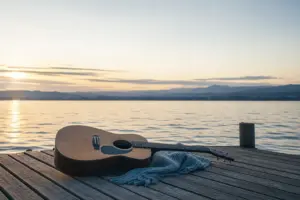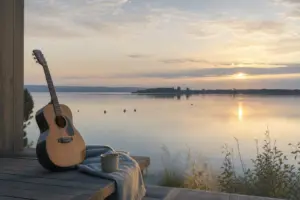
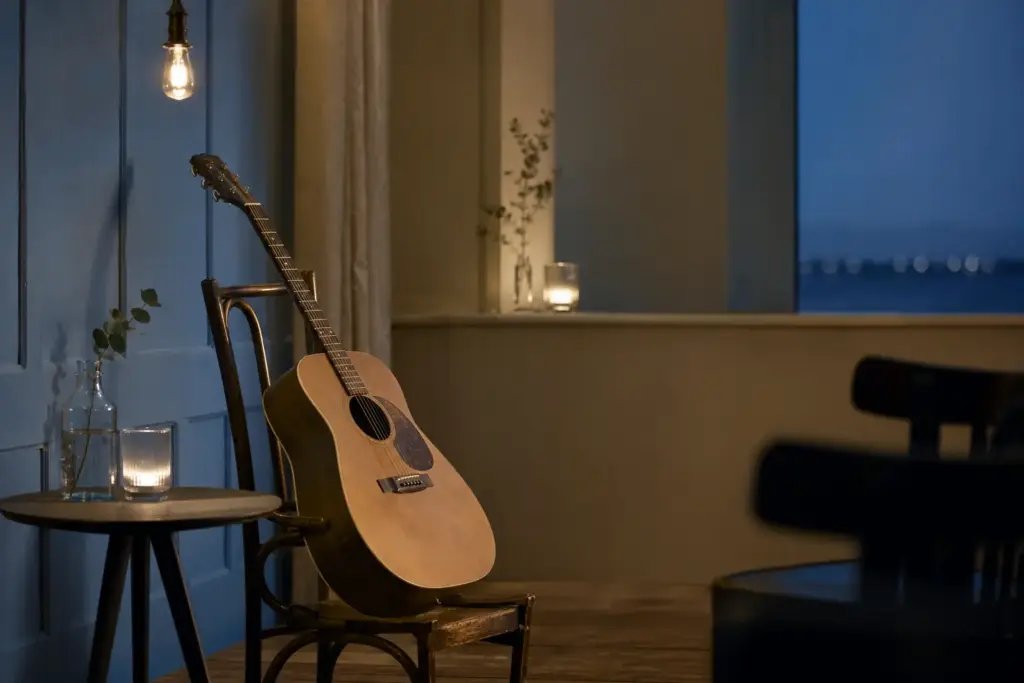
Music, at its best, does not entertain a room. It reaches people. Martin Schloegl singer guitarist, that’s me. That’s the whole belief I’ve built four decades of practice around, which sounds like a lot of ceremony for something that mostly involves me sitting on uncomfortable stools with a guitar, but I mean it all the same. I’m not trying to be technically impressive. I gave up on that ambition somewhere in my twenties. What I’m actually after is something simpler and harder: music that means something to whoever’s listening, because it’s honest, not because it’s clever.
The short version
- I’ve been playing acoustic guitar for more than 40 years, and performing live at private and public events for more than 15 of those
- I write custom songs for weddings, memorial services, and personal milestones, around Lake Constance and occasionally beyond
- I think of music as a language none of us actually had to learn, and that idea quietly runs underneath everything else in this article.
- I teach private guitar lessons to kids and adults around Lake Constance
- Bookings and questions go straight to my inbox, no chatbot, no form pretending to care about your wedding date.
By the time you’re through all that, you’ll probably have a decent sense of why I make the choices I make on stage. And if you’re here because you’re weighing whether to book someone, hopefully a clearer sense of how a custom composition might find its way into your own wedding, memorial, or milestone. Somewhere in there is also a fairly serious argument that music is one of the few languages we all already speak fluently, we just forget we know it, the way you forget you can float until someone finally convinces you to lie back in the water.
Who I Am and What I Actually Do?
Every so often I get asked to write a song for someone I’ve never met. It never happens in one sitting. There’s usually a first conversation, then another, sometimes over days or weeks. Small details surfacing slowly, the way they do when someone’s actually trying to get a person right instead of just describing them: the songs she hummed while cooking, an old joke, the way she cried at weddings that weren’t even hers. I let all of it sit for a while before I touch an instrument. Somewhere in that stretch of listening, a feel for the piece starts to arrive on its own, and only then does a melody show up that the family will later say sounds “exactly like her.” That part of the job still feels slightly impossible to me, even after some years of doing this.
I’m a singer, guitarist, and composer, based around Lake Constance. I play concerts, weddings, memorial services, and I write custom songs for people who want something that belongs to no one but them. I’ve started calling myself a modern bard, half as a joke, half because I just can’t think of a better word for “guy who shows up with a guitar and hopes to read the room correctly.” Medieval bards at least had the excuse that nobody could check their references. I don’t have that luxury. Everyone at a wedding has a phone and an opinion.
I share pieces of this online too — @itsmartinschloegl on Instagram, YouTube and Tiktok, @martinschloeglmusic on Facebook — mostly slow, unhurried clips, which is a polite way of saying I am constitutionally incapable of making anything look exciting for the algorithm. I call what I make “music to remember,” and I mean that almost literally. I think music can lead you back to yourself, underneath all the roles you’ve learned to play. When you remember who you are, you stop needing to work so hard at being someone. Hard work turns into heart work. That’s not a slogan, even though I’m aware it sounds exactly like one. It’s just what I’ve watched happen, over and over, in rooms full of people who came expecting background noise and left looking mildly suspicious about it.
Forty Years In, and It’s Still Not a Career
Forty years with an instrument isn’t really a statistic. It’s more like a long relationship you didn’t plan and can’t quite explain to people who ask how it’s lasted, except this one never once threatened to leave me for someone else. I was six when I heard someone play guitar for the first time, and I decided on the spot, with the full confidence of a six-year-old who understands nothing about commitment, that I needed to learn it too. My parents took that seriously enough to enroll me in a small Hausmusikschule in Bavaria, and that’s where it started.
Not with the acoustic guitar, but with a classical one, the formal kind, scales and pieces and correct hand position, the sort of thing that teaches you discipline whether you asked for it or not. From there the path wandered: classical lessons for a couple of years, then a stretch with the electric guitar, chasing a different kind of sound entirely, possibly because I thought it would make me look cooler. It did not make me look cooler. It took a while to circle back to the acoustic guitar and realize that was the instrument I’d actually been reaching for the whole time. Warm and direct, with nothing between me and whoever’s listening. No effects, no backing track, just hands on strings and a voice that means what it’s saying, and nowhere to hide if it doesn’t.
The Acoustic Guitar as a Deliberate Choice
There’s a kind of stubbornness in that choice now, in an era where you can layer anything onto anything and Auto-Tune your way out of a bad Tuesday. Playing plainly says: I trust this song enough to let it stand on its own, unassisted, like a toddler taking its first steps and occasionally faceplanting in front of everyone.
What Four Decades Actually Build
What forty years actually gives you isn’t authority. It’s intuition, and a lower back that has opinions about certain chairs.
Somewhere along the way (I couldn’t tell you exactly when) I stopped reading the set list like a script and started reading the room instead, adjusting without quite deciding to. That’s the difference between a show and a presence. A show happens on a stage. A presence happens in the room, and you can’t fake your way into it, though I tried, for at least some years.
It’s also the only reason I trust myself at memorial services and small weddings.
Music as a Language Nobody Had to Teach Us
Here’s something I actually believe, not as a poetic flourish but as the thing every decision I make is built on: music is a language we never had to learn. We spend years on spoken language. Grammar, vocabulary, the humiliation of getting corrected in front of the whole class.
But music seems to arrive already installed. Nobody sits a baby down to teach it that a minor chord means something’s wrong. It already knows, and frankly has a better sense of it than most of us adults.
Why This Philosophy Changes Everything
If that’s true, then my job isn’t to impress anyone or to teach them something new. It’s to speak clearly and let them respond, the way they already know how to. That turns a performance into something closer to a conversation than an exhibition. And conversations need two people showing up, not one performing at the other while everyone else checks their watch.
I sometimes think we’ve been sold a story that separates us from each other by default. That we’re isolated individuals who occasionally, with effort, manage to connect, rather than the other way around: fundamentally woven together, occasionally forgetting it. A concert is one of the few places left where that forgetting gets interrupted for an hour. Nobody in the room is a stranger to the sound. The melody doesn’t care about the borders we usually stand behind. Customer and service provider, performer and audience, the guy with the guitar and the people who paid to see him. For a few minutes those roles get thin, and something older and less complicated shows up instead. I don’t think I’m creating that. I think I’m just clearing the debris off a connection that was already there the whole time, like sweeping leaves off a path that existed before I showed up with the broom.
Honesty Over Spectacle
There’s real pressure in this business toward spectacle: bigger sound, bigger stage, more of everything, possibly a pyrotechnics budget. I’ve mostly gone the other way, because the music that actually stays with someone, the kind that’s still there years later, is rarely the music that tried the hardest to impress them.
It’s usually the music that trusted the moment enough to leave space in it. One note where ten would’ve filled the air. That kind of restraint took me years to trust, mostly because for a long time I was terrified that silence meant I’d forgotten the next chord. Nobody applauds you for the note you didn’t play. They just quietly feel something and sometimes blame the venue’s ambience.
Playing Live Around Lake Constance
Most of what I do happens around Lake Constance, though I’ll travel for the right moment. It’s a special, layered region. Switzerland, Germany, and Austria all within sight of each other, three countries arguing amicably over who invented the best bread. That gives me an audience that’s more varied, and maybe a bit deeper, than people would expect from a place by the lake.
Concerts and Public Performances
At concerts, my only real job is to build an atmosphere people actually notice. Not wallpaper, not background music, but something that makes a person set their phone down without deciding to, which these days counts as a minor miracle. I play original songs and I try not to perform for an industry that isn’t in the room. I perform for the people who are.
Weddings and Private Events
Weddings ask for something else entirely: sensitivity, and the ability to read a room full of people who are one glass of prosecco away from either crying or dancing, sometimes both. A ceremony has its own shape — anticipation, arrival, release — and the worst thing I can do is get in its way. The music isn’t the main event. It’s what holds the room together while the main event happens, ideally without anyone remembering there was a guy with a guitar off to the side the whole time. For couples planning a wedding around Lake Constance, I think what live music offers that a playlist can’t is presence. The sense that an actual person is standing there, marking this moment with you, in real time, and also not skipping to the next track because the algorithm got confused.
Memorial Services
Memorial services are where this matters most to me. My job there isn’t really to play music at people. It’s to hold the room, so that whatever needs to move through it has somewhere to go. The music carries the moment rather than filling it. It gives the grief, and everything underneath the grief, a container instead of trying to explain it or smooth it over. I’ve come to think the quietest thing I can offer in that room is also the most useful one: I see that this is hard, and I’m staying right here with you while it is.
Songs Written for One Person, One Time
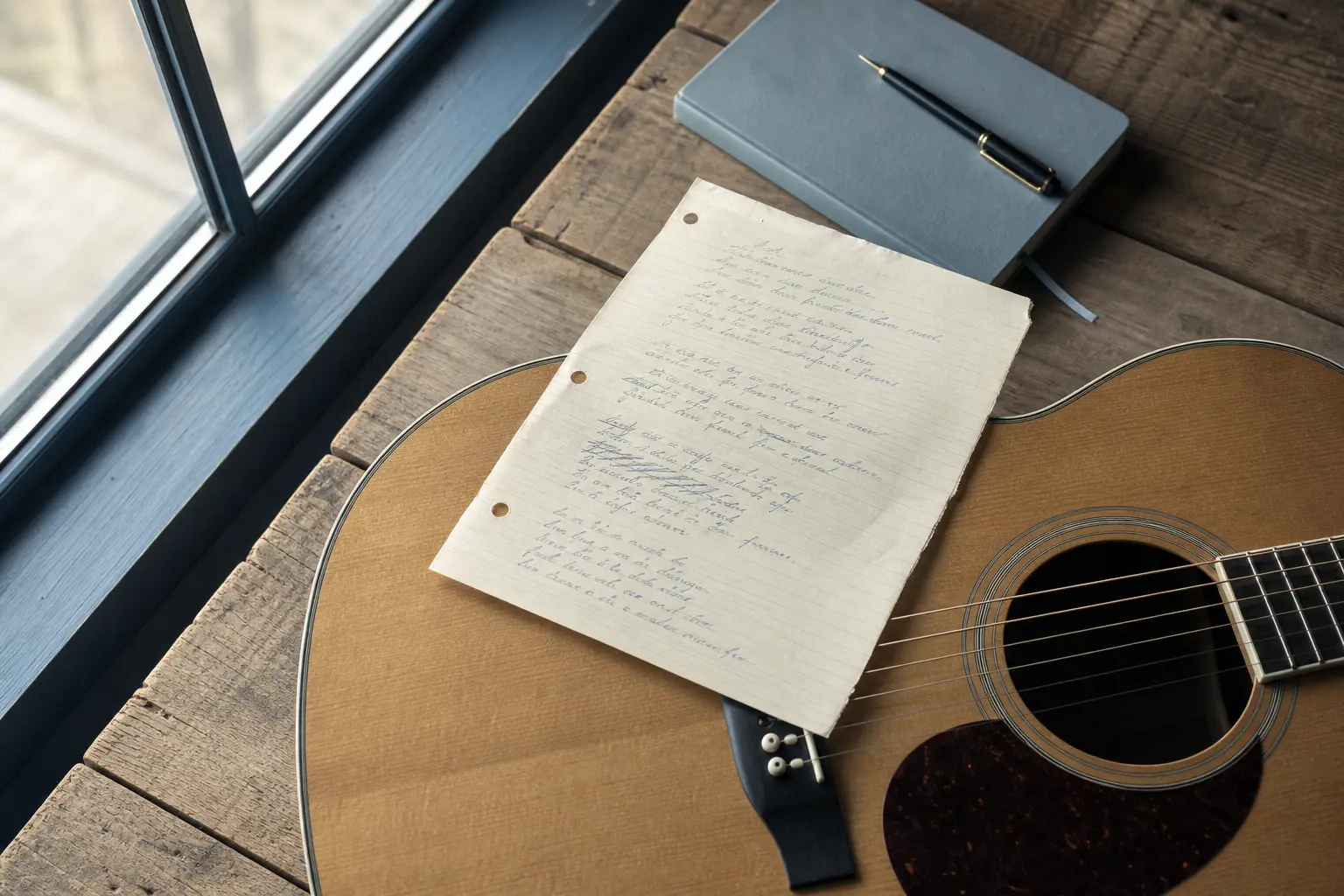
Somewhere along the way, people started asking me to write songs instead of just play them. A piece built entirely around one relationship, one person, one specific joy or loss. This isn’t a playlist with a name dropped in, and it isn’t a cover with the lyrics swapped, though I have been asked, more than once, if I could “just change ‘Sarah’ to ‘Michael’ real quick.” It’s something made from nothing, around a real story.
It always starts the same way: I ask questions, then I mostly shut up and listen. What did she used to say? What’s the joke nobody outside the family gets? What do you want to feel when this plays and everyone in the room turns to look at you, possibly with tears, possibly demanding you play it again? By the time I actually sit down to write, most of the work is already done. The song just needs somewhere to go.
What Makes a Custom Song Different
That specificity is what changes how people hear it. Nobody in that room is listening to a song about someone else’s love story or someone else’s loss. They’re hearing their own story played back to them, and that lands differently, immediately, and for a long time after.
There’s also a more practical layer to this, worth saying once. In Switzerland, musicians who want it have the option of registering original compositions with SUISA, the body that looks after musicians’ rights here. I generally leave that choice with the person the song is written for. A custom piece belongs to their story more than to any registry, and whether to formalize it that way is entirely up to them, not something I push either direction. What matters more to me is simpler: a custom song isn’t a favor or a party trick, it’s a real, original piece of work, built to the same standard as anything else I’d put my name on. Of everything I make, these commissioned pieces are probably the ones that ask the most of me and the ones I take most seriously, precisely because they can’t be swapped out for something else later. You can’t really replace a song like that with a different one. It only exists because that particular life, that particular story, existed first.
I get paid for this, obviously, but the actual exchange happening in the room is a stranger one than money can fully describe. Someone hands me a piece of their life, unfinished and a little raw, and I hand something back that’s shaped like it but somehow says more than they knew how to say themselves. That’s closer to a gift changing hands than a transaction closing. The money makes it sustainable. It’s not what makes it real.
Who Custom Songs Are For
Who actually asks for this varies. Couples getting married, obviously. There’s something about a wedding that makes people suddenly want one thing in the day that couldn’t have happened at anyone else’s wedding. Families saying goodbye to someone, which is its own category entirely and never something I take lightly. A parent marking a kid’s milestone, sometimes just because they want proof, in a form more permanent than a photo, that this particular childhood happened and mattered. The common thread isn’t the occasion. It’s a certain instinct or feeling people have, not always ones who’d call themselves musical at all that the right piece of music, arriving at the right moment, does something a speech simply can’t. I’ve never been able to fully explain why that’s true. I’ve just watched it happen often enough to trust it completely.
Martin Schloegl Singer Guitarist (that’s me ;-)): Teaching Guitar, Which Is the Same Job Backwards
What I do doesn’t really stop when I step off a stage. I also teach guitar, privately, to kids and adults around Lake Constance, and I’ve come to think it’s the same job as performing, just running in the opposite direction. On stage I’m handing something to a room. In a lesson, I’m trying to help someone find something that was already in their own hands the whole time, which turns out to be a slower and, in its own way, more delicate kind of listening than a concert ever asks of me.
Teaching is, in a lot of ways, just another form of conversation. The student shows up with curiosity and a willingness to sound bad in front of another person, which takes more courage than people give it credit for. I show up with patience and some sense of a path through the noise. What happens between us, on the good days, isn’t really instruction. It’s closer to discovery. Mine included, more often than I expected when I started doing this.
Guitar Lessons for All Ages
I teach children and adults, on purpose, not as a scheduling convenience. It comes from the same belief that runs under everything else in this article: music doesn’t check your age or your background at the door. A six-year-old picking out their first chord gets exactly the same seriousness from me as the fifty-year-old who’s finally coming back to an instrument they put down two decades ago, usually with a story about why, and usually a good one.
My approach leans honest over mechanical. I don’t think you learn technique first and then, eventually, get to play music. I think you play music from the very first lesson, badly, cheerfully, and let the technique catch up to the feeling rather than the other way around. That order matters more than it sounds like it should. It’s the difference between someone who sticks with it through the first real wall of difficulty, and someone who quietly stops showing up, having decided, wrongly, that this clearly wasn’t for them..
Building A Bit of A Musical Community
Teaching has also pulled me, gradually and without much planning, into something bigger than one-on-one lessons. From time to time I share guitar tips online alongside stories about other musicians in the area. I’m not trying to build an audience around myself there so much as point a bit of light at the people around me who deserve some.
That kind of sharing is less common than you’d think. A lot of musicians hold their knowledge fairly close, understandably. It took years to earn, why hand it over. I’ve never quite seen it that way. A region with more musicians in it, more people who’ve actually picked up an instrument instead of just listening to one, is a richer place for everyone in it, myself very much included. Teaching and performing have started to feel like two versions of the same conviction rather than two separate jobs I happen to do.
If you want a wider sense of how live music actually gets organized and supported in Switzerland, e.g. venues, associations, the quieter infrastructure that makes any of this possible, then Petzi, the Swiss association of independent music venues, is a useful place to look.
Music Beyond the Room I’m Standing In
I was twenty the first time I went to Bolivia, at an age when you still think you’re going somewhere to see it, and it doesn’t occur to you yet that it might be the other way around. I just had a rucksack and the kind of open mind you only get once in life, before responsibilities show up and start filling it in for you. What I found there wasn’t a cause. It was just a different reality. Kids with enormous curiosity and almost no access to the things I’d never had to think twice about, an instrument being one of the more obvious ones. So I was teaching there for a year. Teaching mathematics and a bit of guitar lessons.
I didn’t come home with a plan. Plans, in my experience, rarely start that cleanly. What actually happened was slower and less deliberate: the memory of that different reality just kept sitting there. And from there a possibity arose to support the communities in Bolivia in terms of music by raising a bit of money in order to purchase instruments for them so that the music keeps playing there as well. This project has been going on for more than 20 years now.
Why This Might Help To Understand Me A Bit Better
I don’t think of it as a separate chapter from the rest of what I do. It feels more like the same story continuing in a direction I didn’t fully choose in advance ; the twenty-year-old who got handed a different reality, slowly turning into someone who tries, in whatever small way is available, to hand a bit of that back or better expressed to pay it forward. Music being a language nobody has to learn only means something if enough people actually get handed the instrument.
The Connection To Yourself?
I bring this up not to make a point about myself, but because I think most people have a version of this somewhere in their own story: a trip, a conversation, a season of life that quietly rearranged what they thought mattered, and never quite got followed up on. I don’t think the question is whether you should go start a project in Bolivia. It’s smaller and more personal than that: is there a thread in your own story, something that already changed how you see things once, that’s just sitting there waiting for you to keep writing it, in whatever modest way is actually available to you, wherever you happen to be standing?
If You Want To Reach Me
Getting in touch is simple: music@martinschloegl.ch. No forms, no chatbot pretending to be enthusiastic about your wedding date. Tell me what the event is, what the moment means to you, what you’d want people to feel when the music starts. Those aren’t formalities. That conversation is where e. g. a custom song comes from, whether it’s a wedding, a memorial, or a set of guitar lessons.
If you’d rather listen first, my music’s on youtube.com/@itsmartinschloegl and Bandcamp (https://martinschloegl.bandcamp.com/). A few minutes of that will tell you more than anything I could write here, and cost you considerably less time than reading this entire article. And if you follow along on Instagram or Facebook, you’ll get the same person you’d get in a room with me: slow-living moments, acoustic guitar, the occasional dog who has strong opinions about my rehearsal schedule. No performance for the algorithm. Just the actual thing.
What to Expect When You Make Contact
I don’t espond to enquiries with a standard rate card or a brochure. I usually respond with a conversation. What is the event? What does the moment mean to you? What would you like people to feel when the music plays?
Those questions are not formalities. They are how the music gets made. Whether you are booking live music for a wedding or requesting a custom composition for a memorial service, the process begins with genuine listening from both sides.
Frequently Asked Questions
What kind of events do I perform at?
I perform at concerts and private events, primarily around Lake Constance, though I am available beyond that region. I also plays at weddings and memorial services. Having performed live for more than 15 years, I bring a steady and honest presence to every setting.
How do you book me for a wedding or private event?
You can reach me directly by email at music (at) martinschloegl.ch. I welcome enquiries for all types of events and will respond with a conversation about what your specific moment needs, rather than a fixed package or price list.
What is a custom song and how do I create one?
A custom song is an original composition written specifically around a person, a relationship, or a life event. I start by listening to the story and the details. I learn the feeling I want the music to carry. I then write a song that belongs entirely to that moment and to no other occasion.
Does I offer guitar lessons, and who are they for?
Yes. I offer private guitar lessons for both children and adults around Lake Constance. The lessons are open to complete beginners and to players returning to the instrument after a break. My approach prioritizes playing music with feeling from the start, letting technique develop naturally from there.
Where can you listen to my music online?
You can watch and hear my music at https://martinschloegl.bandcamp.com/ and on my YouTube channel at youtube.com/@itsmartinschloegl. I am also active on Instagram as @itsmartinschloegl and on Facebook as @martinschloeglmusic, where I shares acoustic guitar moments and musical reflections regularly.
If you are curious about what live music with real depth feels like, visit my website and take the first step. Whether you have an event in mind or simply want to hear more, the door is open. I look forward to hearing from you.