
Pick up an acoustic guitar and you already hold more sonic range than most instruments can offer. Acoustic guitar playing styles are the distinct technical and musical approaches a player uses to draw sound from the instrument, ranging from the gentle plucking of fingerstyle to the rhythmic drive of percussive body tapping. Each style carries its own vocabulary and its own set of rewards. Knowing them does not mean you have to choose just one.
Key Takeaways
- Acoustic guitar playing styles include fingerpicking and flatpicking as foundational techniques. Travis picking and alternate picking expand the range further, while classical technique, slide guitar, and percussive playing each produce a distinct sound and feel.
- Fingerstyle acoustic guitar allows a single player to cover melody and accompaniment at the same time, making it one of the most self-sufficient approaches on the instrument.
- Flatpicking uses a plectrum rather than bare fingers and is central to country and bluegrass genres. Folk music also relies heavily on this technique.
- Percussive acoustic guitar techniques, such as body tapping and slap harmonics, have grown into a recognized style of their own rather than a mere novelty.
- Mixing acoustic guitar playing styles is not only acceptable but is how most working players develop a recognizable personal sound.
By the time you finish reading, you will be able to name each major style and understand what makes it technically distinct. You will also be able to decide which ones are worth adding to your own practice. That clarity alone can save months of unfocused noodling.
Fingerstyle and Fingerpicking: The Foundation of Solo Acoustic Guitar
Fingerstyle is the approach where each string is plucked directly by a finger or thumb rather than by a pick. It lets a single player carry melody and harmony simultaneously while also managing a bass line. That independence is what makes it so appealing and so demanding. You are, in practical terms, playing at least two parts simultaneously.
The thumb typically handles the lower strings, walking a steady bass pattern while the fingers pick out a melody or inner voices on the higher strings. Getting those two layers to feel relaxed and equal in volume takes time. Most beginners find the thumb easy to control and the fingers erratic, or the reverse.
Different genres have shaped fingerstyle into recognizable sub-styles. Celtic and folk players tend to favor a bright, close-to-the-bridge tone. Singer-songwriters often keep things warmer and more subdued, sitting the picking hand further toward the sound hole.
The technique also asks something of the left hand. Because you are producing multiple independent voices, muting unwanted strings intentionally becomes part of the craft. A note left ringing when it should not will muddy the bass line or blur the melody.
According to a Berklee College of Music overview of guitar playing styles, fingerstyle sits alongside classical and jazz as one of the approaches that rewards the most deliberate long-term study. That is not a discouragement. It is an honest statement about what the style gives back over time.
One practical note: nail length matters more than most beginners expect. A small amount of nail on the plucking fingers produces a cleaner, more articulate tone. Too much nail and the attack gets brittle. No nail at all and the tone softens considerably, which can be exactly what a particular song needs.
I offer private guitar lessons around Lake Constance for both children and adults. Fingerstyle is almost always the technique that students want to reach eventually, even when they start with something simpler. That gap between wanting it and being able to do it is real, but it closes faster than people expect with the right approach.
Flatpicking and Strumming: Rhythm and Melody With a Plectrum
Flatpicking simply means using a plectrum, a flat pick, rather than bare fingers. The term comes from country and bluegrass circles, but the approach itself is universal. If you are holding a pick and playing an acoustic guitar, you are flatpicking, whatever genre you are playing.
Strumming is flatpicking in its most direct form. The pick sweeps across multiple strings in a single motion, producing a chord that fills space immediately. The rhythm patterns built from strumming are what underpin the vast majority of songs most people learn first.
But flatpicking is not limited to strumming. Players like Doc Watson and Tony Rice used a plectrum to execute fast, clean single-note lines that rival anything a fingerstyle player can produce. The pick gives a brightness and attack that bare fingers cannot quite replicate, which is why bluegrass lead lines sound the way they do.
Pick thickness changes the character of the sound noticeably. Thin picks flex more and produce a softer attack with more high-frequency sparkle. Thick picks are rigid and deliver a fuller, more controlled tone. Most acoustic flatpickers settle somewhere in the middle, around 0.8 mm to 1.0 mm. Personal preference tends to win in the end.
Strumming patterns are also more varied than beginners initially realize. A straight down-stroke on every beat produces a very different feel from a syncopated pattern that skips beats and lands on the spaces between them. Learning to internalize those rhythmic gaps, rather than just strumming mechanically, is what separates a convincing strummer from one who sounds slightly robotic.
The angle of the pick against the strings also matters. A more parallel angle gives a warmer, rounder attack. Tilting the pick slightly produces a brighter, more cutting tone. Most players develop their own angle unconsciously, which is fine until they want to change their sound and cannot figure out why it is not changing.
Travis Picking and Alternating Bass Patterns
Travis picking is a specific fingerstyle pattern named after country guitarist Merle Travis. It is one of the most recognizable sounds in American acoustic music. The thumb alternates between two bass strings on the beat while the fingers pick melody notes on the treble strings in the spaces between.
What makes Travis picking distinctive is that the bass and melody move independently. The thumb keeps a steady, almost metronomic pulse on the lower strings while the fingers respond more freely above. To an untrained ear it sounds like two guitarists playing at once.
Learning Travis picking requires building what is called “thumb independence.” The thumb has to keep going without the brain actively directing it, so the conscious attention can move to the melody line. That takes most people longer than they want it to. There is no shortcut around the repetition required.
The pattern is used in country and folk music. Blues players have also made it central to their sound. Chet Atkins took the foundation Merle Travis laid and pushed it into something even more elaborate, adding chord fills and melodic counter-lines that made the style a performance form in its own right.
From a technical standpoint, Travis picking places specific demands on the fretting hand too. Chord shapes must be held cleanly and sometimes shifted while the picking hand continues without pausing. Partial chord shapes, or “grip-and-slide” movements, become useful tools as the patterns grow more complex.
Once the independence is established, the style becomes genuinely expressive. You can lean into the bass line for a heavier groove, or pull back on it and let the melody dominate. That kind of control is why Travis picking sits at the heart of so many acoustic guitar playing styles that followed it.
Alternate Picking on Acoustic Guitar: Speed and Precision
Alternate picking is the strict application of down-up-down-up picking direction to every note, regardless of which string is being played. It is precise by design. It is the primary tool for playing fast single-note lines cleanly on an acoustic guitar.
On electric guitar, players often rely on legato techniques like hammer-ons and pull-offs to create speed with minimal pick strokes. On acoustic guitar, legato is harder to control at consistent volume, so alternate picking becomes more important. The attack of each individual note stays even, and the sound carries clearly without amplification.
The challenge is in the synchronization. The picking hand must change direction exactly as the fretting hand fingers a new note. When those two actions fall slightly out of sync, the result is a slight clicking or doubling sensation that is very audible on an acoustic instrument. The acoustic guitar hides nothing.
Players who practice alternate picking slowly and build tempo gradually tend to develop cleaner technique than those who push for speed early. A metronome is the most honest tool for this. You cannot argue with a click.
Alternate picking is central to bluegrass flatpicking, where a passage might demand fast runs across multiple strings in a single bar. It is also used in folk melody playing and in any acoustic context where single-note runs need to be heard cleanly in a room without a sound system behind them.
The style rewards patience more directly than almost any other technique. Two weeks of slow, careful practice produces more usable speed than two weeks of pushing too fast and reinforcing sloppy habits. That is not a comfortable truth, but it is an accurate one.
Classical Guitar Technique and Its Acoustic Guitar Cousins
Classical guitar technique is a complete system developed over centuries. It differs from most other acoustic guitar playing styles in almost every physical detail. The guitar is held on the left leg with the neck angled upward. The right hand plucks with precise nail-and-flesh contact, while the left hand presses strings with curved fingers and a thumb kept behind the neck.
The posture is not arbitrary. It positions both hands for maximum efficiency and reduces strain over long practice sessions. Players who switch from steel-string acoustic to classical often find the physical re-learning more disorienting than the music itself.
The repertoire ranges from Renaissance lute transcriptions to contemporary compositions written in the last decade. Classical technique produces a wide dynamic range and a strong separation between voices, which is why it became the basis for so much solo guitar music written across so many eras.
Steel-string acoustic players borrow from classical technique regularly, even when they do not realize it. The concept of rest stroke versus free stroke, where the finger either comes to rest on the next string or passes through freely, shapes tone in fingerstyle playing regardless of genre.
Arpeggios, the picking out of chord tones one at a time, are shared between classical and fingerstyle acoustic playing. In classical music, arpeggios are often written as fixed patterns across a held chord shape. In folk and pop, they are used more freely, mixed with strumming or melody lines.
The Swiss music rights organization SUISA recognizes classical guitar as a distinct performance category, which reflects how differently the industry treats this technique from general acoustic playing. That distinction matters when you are thinking about repertoire and performance context.
Slide Guitar: Open Tunings and the Sound of the Blues
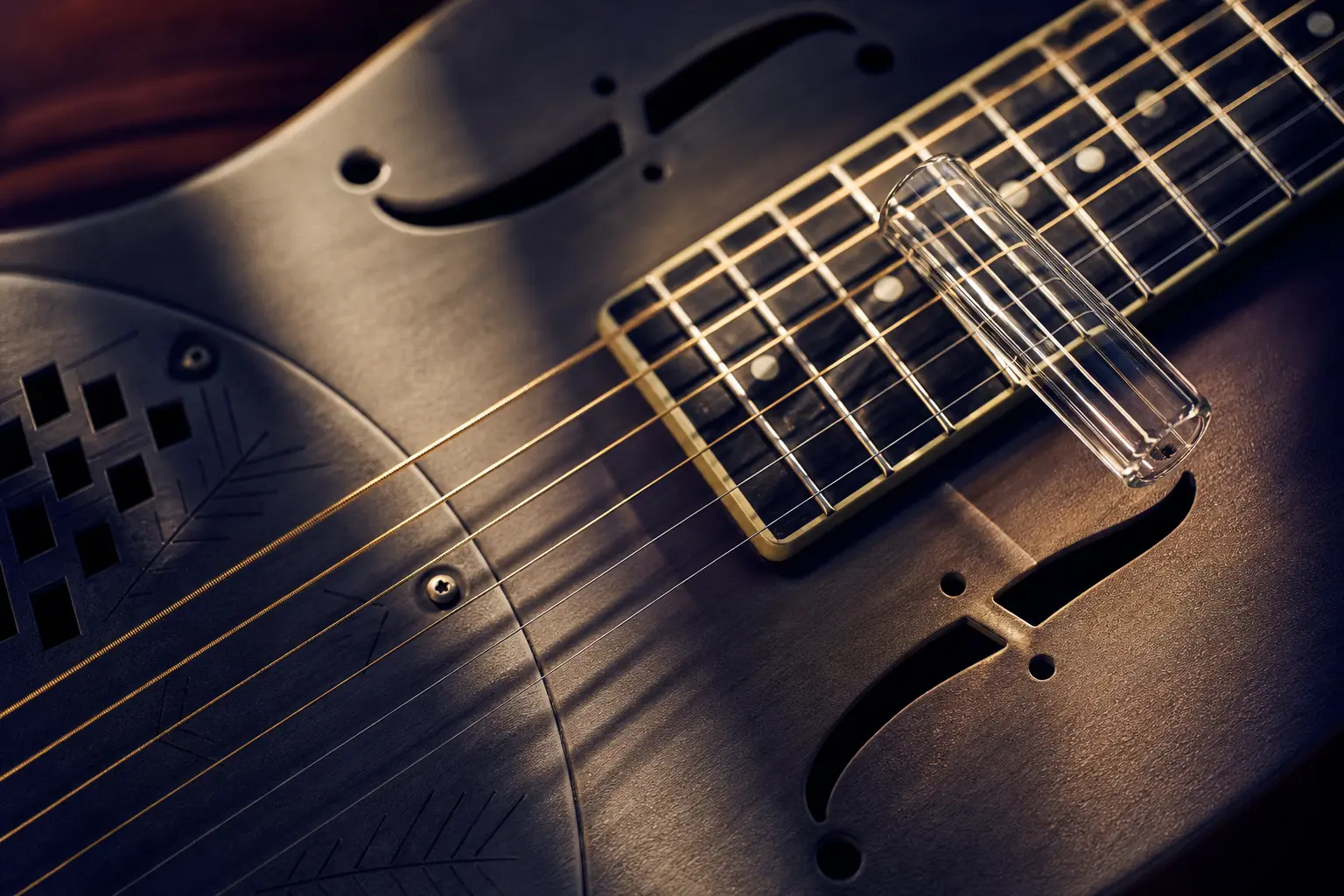
Slide guitar involves pressing a glass or metal tube against the strings rather than fretting them with the fingers. This produces a smooth gliding sound that cannot be replicated any other way. On acoustic guitar, the sound is raw and resonant in a way that suits blues and gospel equally well. Country players have embraced it too.
Most slide playing uses open tunings, where the open strings form a chord. Open D and Open G are the most common choices. The slide can then move freely up the neck while the open strings ring behind it, producing the layered, drone-based sound that defines Delta blues.
Controlling a slide well is harder than it looks. The slide must float just above the strings without pressing them to the fretboard. Too much pressure kills the sustain and produces a muted, buzzy sound. Too little and the notes go sharp. Getting that contact point consistent requires focused practice.
The fretting hand fingers behind the slide also matter. They mute the strings above the slide position, preventing sympathetic ringing from strings the slide is not intentionally activating. That muting work is almost invisible when it is done well and glaringly obvious when it is not.
Acoustic slide guitar, especially on resonator guitars, has a physical presence in a room that amplified electric slide does not quite replicate. The volume is more limited, but the tone is direct and immediate in a way that works well in quieter listening settings.
For players coming to slide from standard technique, the biggest adjustment is usually intonation. The ear has to do work that frets normally do. That ear training is not wasted. It feeds back into everything else you play.
Percussive Acoustic Guitar Playing Styles and Body Tapping
Percussive acoustic guitar technique treats the body of the guitar as a drum while the strings continue to function as a melodic and harmonic instrument. Body tapping and slap harmonics create rhythm tracks that run simultaneously with melody and bass lines. Thumb slaps on the strings add another percussive layer.
Players like Andy McKee and Erik Mongrain brought this approach to wide attention in the early internet era. Their videos circulated widely because the sound, when done well, genuinely confounds people. It does not sound like one person playing one instrument.
The technique requires a guitar that responds well to percussive contact. A guitar with a thin, responsive top produces clearer tap tones. A heavy-topped instrument might sustain better for standard playing but muffle the percussive elements.
Body tapping has specific zones. The lower bout near the bridge produces a bass-drum-like thud, while the upper bout gives a higher, snappier sound. The area around the sound hole responds differently again. Learning which area to use for which rhythmic function is part of the technique’s own internal vocabulary.
String slaps, where the thumb or finger pulls the string away from the body and releases it so it snaps back, add another layer. When combined with standard fingerpicking in the same phrase, the effect is genuinely complex to listen to and to execute.
According to a GuitarGuitar guide to guitar playing styles and techniques, advanced percussive techniques represent one of the most technically demanding branches of acoustic playing. That assessment is fair. This is not a style that rewards casual practice.
Mixing Acoustic Guitar Playing Styles to Build Your Own Sound
Most working acoustic guitarists do not sit cleanly inside one style. They borrow. A fingerpicker who uses a pick for strummed sections. A flatpicker who applies open tunings for slide passages. A classical player who brings that right-hand precision into folk repertoire. The mixing is the point.
Building a personal sound from multiple acoustic guitar playing styles is not a shortcut or a compromise. It is how the instrument’s range actually gets used. The players whose sound is most immediately recognizable are almost always those who assembled their own combination rather than staying rigidly inside one tradition.
The practical question is sequencing. Which style do you learn first, and when do you add the next one? Most teachers, including those who have spent years working with students across different levels, would say: build one foundation well before pulling in a second. Trying to develop two styles simultaneously often means developing neither properly.
That said, awareness of other styles changes how you hear your primary one. A fingerstyle player who understands Travis picking will hear bass lines differently. A strummer who learns some alternate picking will hear rhythm guitar differently. Cross-pollination sharpens attention even when you are not actively practicing the borrowed technique.
Having performed live music for more than 15 years at concerts and private events, I have found that the most versatile acoustic sets draw on at least two or three distinct techniques within a single performance. The shift between styles gives the music shape and keeps a room’s attention in a way that one sustained approach rarely does.
If you want to see these styles performed in a live context, the live guitar music and events page gives a sense of how different techniques translate into a real performance setting. There is a gap between understanding a style technically and hearing it function in an actual room. Closing that gap is worth your time.
The acoustic guitar also rewards a kind of lateral curiosity. Something absorbed from a slide guitarist might change the way you handle vibrato in a fingerstyle piece. A percussive tap rhythm might reorganize how you think about strumming accents. The styles are not sealed compartments. They inform each other in ways that are hard to predict and easy to enjoy once they start happening.
For players around Lake Constance looking to explore these ideas with guidance, the solo musician page offers more context about how a working acoustic player integrates these approaches in practice.
Frequently Asked Questions
What is the easiest acoustic guitar playing style to learn first?
Strumming with a pick is generally the most accessible starting point. The movements are larger and easier to see, and a few basic strumming patterns cover a wide range of songs quickly. Most beginners find fingerpicking harder to coordinate at first, though it rewards longer study.
How long does it take to learn fingerstyle guitar?
Basic fingerpicking patterns can be learned in a few weeks of consistent practice. Getting to the point where melody and bass feel natural and independent typically takes one to two years for most adult learners. Inner voices take additional time. The exact timeline depends on how much focused practice time you put in each day.
Can I use a pick for fingerstyle playing?
Some players use a thumb pick and fingerpicks simultaneously, which gives the attack of a plectrum with the independence of fingers. Others combine a flat pick with bare finger playing, sometimes called hybrid picking. Both approaches are legitimate and used by working players across folk, country, and blues.
What guitar styles work best for live acoustic performance?
Fingerstyle and Travis picking carry well in quiet listening environments because they produce a full, self-contained sound without a band behind them. Flatpicking and strumming work well in louder or larger settings where rhythmic drive is needed. Percussive techniques can be striking in either context when the room acoustics support them.
Do I need to learn music theory to develop my acoustic playing style?
No, but some theory knowledge helps significantly. Understanding how chords are built makes it easier to adapt fingerpicking patterns to new keys. Knowing basic scale positions helps with single-note flatpicking runs. You can develop a personal style without formal theory study, though it tends to take longer without it.
If you are curious about taking any of these acoustic guitar playing styles further, whether through lessons or live performance, feel free to get in touch. A short conversation is usually enough to find the right direction.