

Most people assume the hard part is the notes. It isn’t. Singing while playing guitar is the art of splitting your attention between two learned skills and eventually making that split invisible. It is one of the most rewarding things you can do as a musician. The good news is that coordination between voice and hands is trainable. You do not need a rare gift. You need a method and a little patience.
Key Takeaways
- Singing while playing guitar requires separating the two skills first, then combining them gradually once each feels automatic on its own.
- Choosing songs in the right key for your voice is a foundational step that removes unnecessary strain before you even start practicing coordination.
- Muscle memory is what allows guitar playing to run in the background while your attention shifts to your vocals.
- Dynamic interplay between voice and guitar lifts a performance well beyond basic coordination. Strumming softer under a delicate vocal line is one example.
- Starting with simple chord patterns and a slow tempo is not a shortcut; it is the fastest reliable route to consistent results.
By the end of this guide, you will understand exactly why your brain fights you when you try to sing and play at the same time. You will also have a clear sequence of steps to move through at your own pace, so the two skills start to feel like one.
Why Singing While Playing Guitar Feels So Hard at First
Your brain is not broken. When you first attempt to sing and play at the same time, the cognitive load is simply higher than either task alone. That overload is completely normal. Both skills compete for attention in the same mental workspace, and until one of them is automatic, they pull against each other.
Think of it the way a child learns to walk. At first, every step demands full concentration. Later, walking runs in the background while the child talks or carries something. Guitar playing needs to reach that same background state before your voice can move freely in the foreground.
The technical term for this is automaticity. Research into motor learning confirms that practiced physical tasks eventually shift from the prefrontal cortex to deeper motor circuits. The prefrontal cortex is where conscious attention lives, while the deeper circuits operate without deliberate oversight. A Journal of Neuroscience study on motor learning and automaticity found that repeated practice physically changes how the brain routes a task, freeing up higher cognitive resources for a second simultaneous activity.
That is actually encouraging news. It means the difficulty you feel right now is not a ceiling. It is just where you are in the process.
Many beginners also make the mistake of attempting songs that are too complex for their current guitar level. If the chord changes still require conscious thought, adding a vocal melody on top will always fail. The solution is not to try harder. It is to go back and simplify.
One thing I notice when students first come to me for guitar lessons, is that the ones who struggle most with combining voice and guitar are often the ones who rushed past the point where their chord transitions became truly automatic. They can play the chords. They just can’t play them without thinking about playing them. That distinction matters enormously.
Building Muscle Memory: The Foundation of Guitar Coordination
Muscle memory is the mechanism that makes singing while playing guitar possible. Until your fretting hand and strumming hand can move through a chord progression without conscious direction, your vocal line will always struggle for space in your attention.
The way to build that memory is repetition at a slow tempo. Not medium-slow. Actually slow, slow enough that you can execute every transition cleanly with zero hesitation. Speed is something you add afterward, in small increments, only once the slow version is solid.
A metronome is not optional at this stage. It gives your hands a reliable pulse to anchor to, which means your brain spends less energy on timing and more on the physical feel of each chord shape. Over time, the pulse becomes internal.
Practice the guitar part alone until you can play through it while carrying on a simple conversation. That sounds like a low bar, but it is actually a meaningful test. If a question breaks your strumming pattern, the pattern is not yet automatic enough to carry your vocals.
Here is a comparison of practice approaches and what each one targets:
| Practice Approach | What It Builds | When to Use It |
|---|---|---|
| Slow chord loops with metronome | Physical accuracy and timing | First stage — before adding vocals |
| Playing while speaking aloud | Dual-tasking readiness | Before introducing the actual melody |
| Humming melody over guitar | Pitch and rhythm coordination | Bridge between pure guitar and full singing |
| Full run-through at tempo | Integration and flow | Once both parts feel comfortable separately |
Humming is an underrated intermediate step. Before you add words, hum your vocal melody over your guitar part. This introduces pitch and phrasing coordination without the cognitive weight of lyrics. Many players skip this and go straight to singing full words, then wonder why it falls apart.
Give the muscle memory stage more time than feels necessary. It is almost always the place where progress compounds quietly, then seems to arrive all at once.
Finding the Right Key for Your Voice
Playing a song in the wrong key is one of the most overlooked reasons people struggle to sing and play guitar at the same time. If your voice is straining to reach notes, a large portion of your attention will divert to managing that strain. Your guitar playing will suffer as a result.
Before you invest time learning a song’s guitar part, check whether the original key sits comfortably in your vocal range. Sing through the melody a cappella. If you find yourself reaching at the top or bottoming out at the low end, capo up or down before you commit to the guitar work.
A capo is a simple tool that lets you keep familiar chord shapes while shifting the key of the whole instrument. If a song sits one step too high for your voice, place a capo at the second fret and play the same shapes you already know. The guitar sounds different; your hands do exactly the same thing.
You can also transpose without a capo by relearning the chord shapes in a different key entirely. That approach takes more work but can reward you with a more resonant guitar tone in some cases. For most beginners and intermediate players, the capo is the smarter starting point.
Once the key is right, something else happens: you stop fighting the song. Your voice finds the melody more naturally, and your breathing steadies. The whole performance relaxes in a way that listeners can actually hear. Comfort in the voice feeds directly into comfort in the hands.
If you want to explore what that kind of integrated, comfortable performance looks and sounds like, the songwriter and singer work on this site is a good place to get to know a musician and go from there to explore his music.
How to Practice Vocals and Guitar Parts Separately
Practicing the two parts in isolation before combining them is not a workaround for a weakness. It is the method. Every player who combines voice and guitar well went through a stage, consciously or not, where they knew each part well enough to run it without thinking.
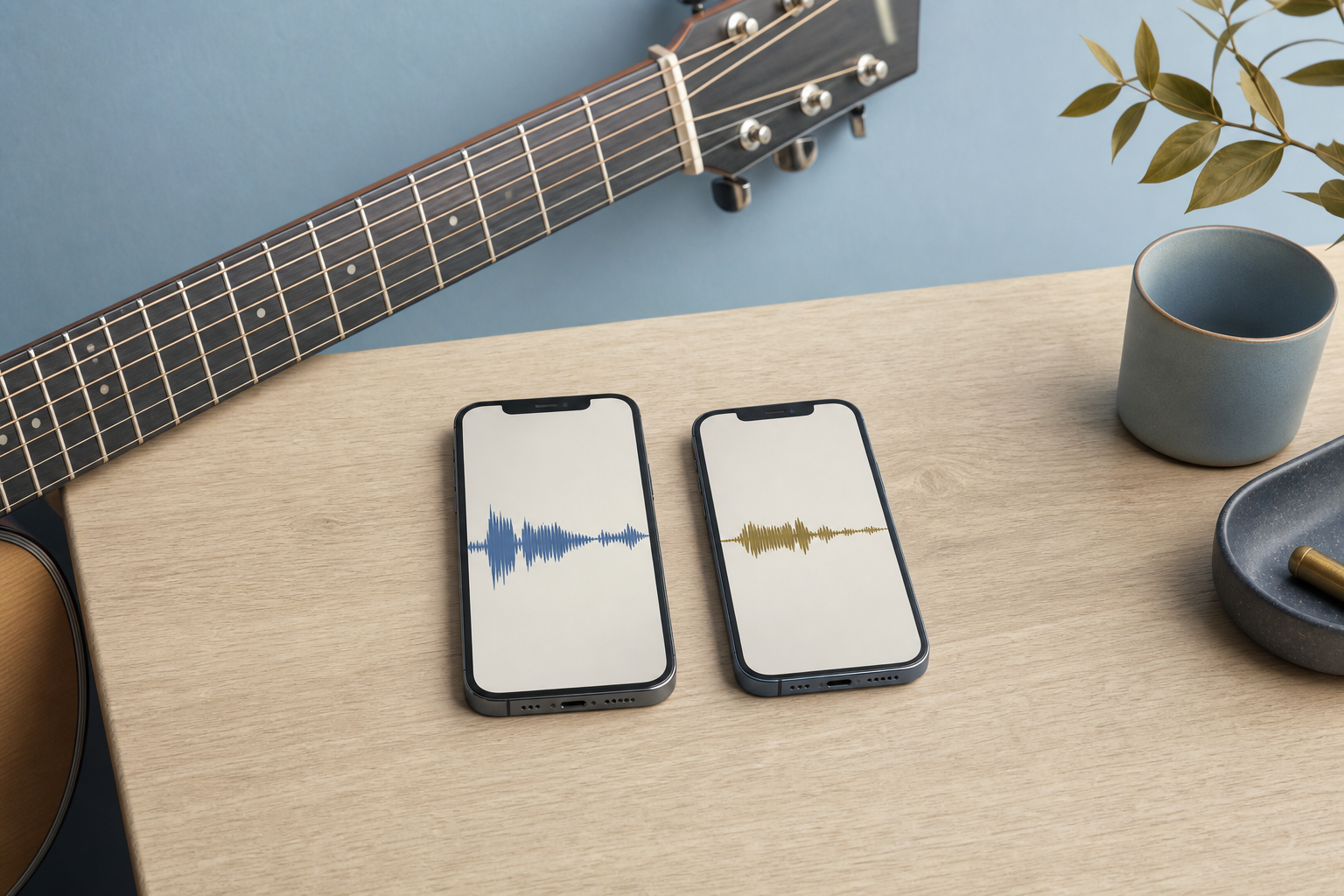
Start by recording your guitar accompaniment on your phone. Nothing fancy. A voice memo is enough. Then play that recording back and sing along to it, with your hands free and your full attention on your vocal line. Notice where the melody sits in relation to the chord changes, and pay attention to where you breathe and where that timing gets tight.
Then reverse it. Record your vocal melody a cappella, just voice, maybe with a metronome click in the background. Play your guitar along to the recording. This forces your guitar playing to follow the vocal timing rather than the other way around. It is surprisingly revealing. You will discover quickly whether your guitar transitions are clean enough to keep up with a vocal phrase that doesn’t wait.
This two-recording approach, outlined by guitar educators at Acoustic Guitar magazine, is one of the most practical methods for breaking down the coordination problem into manageable pieces. You are essentially practicing listening and reacting before you practice doing two things simultaneously.
Repetition in this separate phase is where the real work happens. Run the guitar part until it genuinely bores you. That boredom is the signal that automaticity is arriving. Then bring the voice back in and see what has changed.
What typically changes is: more. You can hear yourself and adjust pitch in real time. You can feel the groove rather than just execute it. The song starts to breathe.
Choosing the Right Songs to Start With
Song choice is a strategic decision, not a sentimental one, at least at the beginning. The song you love most is probably not the right starting point. The right starting point is a song whose guitar part your hands can run on near-autopilot, and whose vocal melody sits in a comfortable part of your range.
Look for songs built on a simple, repeating chord pattern. Two or four chords that cycle predictably give your hands a groove to lock into without surprises. Surprises require attention. Attention is what you need for your voice.
Steady, even strumming patterns work better than complex fingerpicking arrangements when you are first combining the two skills. Fingerpicking requires more precise finger independence, which means it demands more conscious monitoring. A simple down-up strum pattern that matches the song’s pulse is enough to hold the harmonic foundation while your vocal takes the lead.
Here are qualities that make a song a good starting candidate:
- The chord changes happen at predictable, regular intervals, not mid-phrase or on weak beats.
- The vocal melody moves mostly in a comfortable middle part of your range, with minimal extreme leaps.
- The lyrics have a natural speech-like rhythm that makes it easy to feel where words land against the beat.
- The tempo is moderate, fast enough to feel like a song yet slow enough to give you room to think.
Folk and country songs tend to fit these criteria well, and acoustic pop works too. Many of the most enduring songs in those genres are built on exactly two or four chords. That simplicity is not a limitation. It is the reason they work for both listener and performer.
Once you can sing and play through your first simple song without losing either part, move up in complexity gradually. The confidence you build from completing one song cleanly carries directly into the next.
Understanding Timing and How Vocals Interlock With Guitar When Singing While Playing
Timing is where most players get stuck after they have the basics in place. The guitar part and the vocal line are not two separate streams running in parallel. They interlock, and understanding how they fit together is what makes the combination feel like a real performance rather than two things happening at the same time.
Most songs have a simple rhythmic relationship between voice and guitar: the vocal melody sits on top of the guitar’s pulse, and chord changes often happen at the start of a vocal phrase or just before a key lyric. Once you know where those anchor points are, the song becomes a map you can navigate reliably.
A useful exercise is to speak your lyrics in rhythm over your guitar part, without worrying about pitch. Spoken words are easier to time than sung ones because you’re not simultaneously managing pitch. If the spoken rhythm flows, the sung version will generally follow.
Some vocalists sing slightly ahead of the beat, and pulling the melody forward gives the voice a feeling of urgency and presence. Others sit just behind it, which creates a more relaxed, conversational quality. Neither is wrong. But you need to know which you’re doing, because inconsistency between the two approaches in the same song is where timing problems actually live.
A metronome remains useful here, even at this more advanced stage. Use it to check whether your combined tempo is drifting. Singers often slow down at difficult passages and speed up when they feel confident. That variation, over the length of a song, can unravel an otherwise solid performance.
Research published by the University of Oxford’s music cognition research group has explored how trained musicians process rhythmic synchronization differently from novices, finding that experienced players internalize beat structures at a level that operates below conscious awareness. That internalization is what you are building toward.
Creating Dynamic Interplay Between Voice and Guitar
Once coordination stops being the primary challenge, a new and more interesting question opens up: how do your voice and guitar actually talk to each other? Dynamic interplay is what separates a well-executed performance from one that reaches people.
The simplest version of this is volume. Play more softly under a delicate or intimate vocal passage. Let the guitar swell when the chorus arrives and the voice lifts. This is not complicated to execute, but it requires you to be listening to yourself as a whole, not just monitoring each hand independently.
Strumming style is another lever. Shifting from quiet fingerpicking on a verse to full open strumming for a chorus creates a dynamic arc that the listener feels physically. The voice doesn’t have to do all the work of signaling an emotional shift; the guitar can share that load.
Melodic fills are a more advanced tool. In the space between vocal phrases, the brief silences where you take a breath, a short guitar figure can answer or echo what the voice just said. This is the kind of detail that audiences often can’t name but always notice. It is what live guitar performance has that a backing track doesn’t.
Having performed live music at concerts and private events for more than 15 years, I’d say this interplay quality is the hardest thing to teach and the most immediately apparent thing to audiences. They feel when the guitar and voice are in real conversation. They also feel when the player is just keeping the parts from colliding.
Working on dynamic interplay is also where singing and playing guitar becomes genuinely compositional. You are no longer just reproducing a song. You are making decisions about it in real time, and those decisions shape what the listener experiences. That shift in perspective, from reproduction to interpretation, is worth sitting with.
For inspiration on what that sounds like in practice, the live guitar music and events page on this site offers a sense of how voice and guitar can work together in a real performance setting embedded in a before-and-behind-the-scenes kind of style.
Common Mistakes and How to Fix Them
Most players who struggle with singing while playing guitar are making one of a small number of identifiable mistakes. The good news is that each one has a direct fix once you can name it.
Rushing through the muscle-memory stage. This is the most common. Players start combining voice and guitar before the guitar part is truly automatic. The fix is simple and slow: go back to the guitar part alone, reduce the tempo until every transition is clean, and stay there until playing it bores you.
Holding the breath. Singers sometimes unconsciously stop breathing normally when they add the guitar, because they’re concentrating. This tightens the throat and flattens the tone. Practice your vocal phrases with deliberate attention to breath. Know exactly where you inhale and make that as automatic as a chord change.
Staring at the fretboard. If your eyes are down during performance, your posture collapses and your voice closes off. Learn the chord shapes well enough to play without looking. This is not vanity; it changes the physical position of your head and throat, which directly affects vocal resonance.
Matching the vocal rhythm exactly to the guitar strumming pattern. When every word lands on a strummed note, the performance sounds mechanical. Let the vocal line breathe across the strumming pattern rather than aligning to it beat by beat. The voice should float above the guitar, not march alongside it.
Practicing at full speed too early. Speed makes every error faster and harder to catch. If something keeps going wrong at full tempo, the answer is almost never to repeat it at full tempo and hope. Drop the speed, find where the problem actually starts, and rebuild from there.
These mistakes are not signs of a lack of talent. They are exactly the mistakes that systematic practice is designed to catch and correct. Every player who can now sing and play guitar well went through a version of this same list.
Frequently Asked Questions
How long does it take to learn to sing while playing guitar?
There is no single timeline, because it depends on how automatic your guitar playing already is and how comfortable you are with your vocal technique. Many players see meaningful improvement within a few weeks of focused separate practice, then gradual integration over one to three months. If your chord transitions are already solid, the coordination stage can move faster than you expect.
Is it easier to sing while playing guitar if I already know how to sing well?
Vocal skill helps, but it is not the most important factor. The guitar side is usually the limiting one, because the guitar part needs to become automatic before the voice can move freely. A player with modest vocal ability and very solid guitar automaticity will often combine the two more smoothly than a strong singer whose guitar playing still requires conscious attention.
What is the best strumming pattern to use when singing and playing at the same time?
Start with the simplest pattern that fits the song, often a basic down-strum on each beat or a gentle down-up pattern. Complexity in the strumming pattern competes directly with your vocal attention. Once the combination is solid with a simple pattern, you can gradually introduce more rhythmic detail without losing the vocal line.
Should I use a capo when learning to sing while playing guitar?
Yes, if the original key of a song sits uncomfortably in your range. A capo lets you move the pitch of the song without changing the chord shapes you already know. Reducing vocal strain is one of the fastest ways to free up attention for coordination, so finding the right key is worth doing before you invest practice time in a song.
Why does my guitar playing fall apart when I start to sing?
Almost always, it means the guitar part is not yet automatic enough to run without conscious attention. As soon as you add the cognitive load of singing, the attention your guitar playing was borrowing disappears. The solution is to return to the guitar part alone, slow the tempo significantly, and practice until the chord changes feel effortless before reintroducing your voice.
If you would like to explore this further or have a question about guitar playing and performance, feel free to get in touch with Martin. He welcomes hearing from those just starting out and those looking to take their live performance in a new direction.